


Go back to News
NEWS
Gómez-Acebo & Pombo inaugurates its #GA_Pproud forum with Minister Marlaska
 1 July, 2021
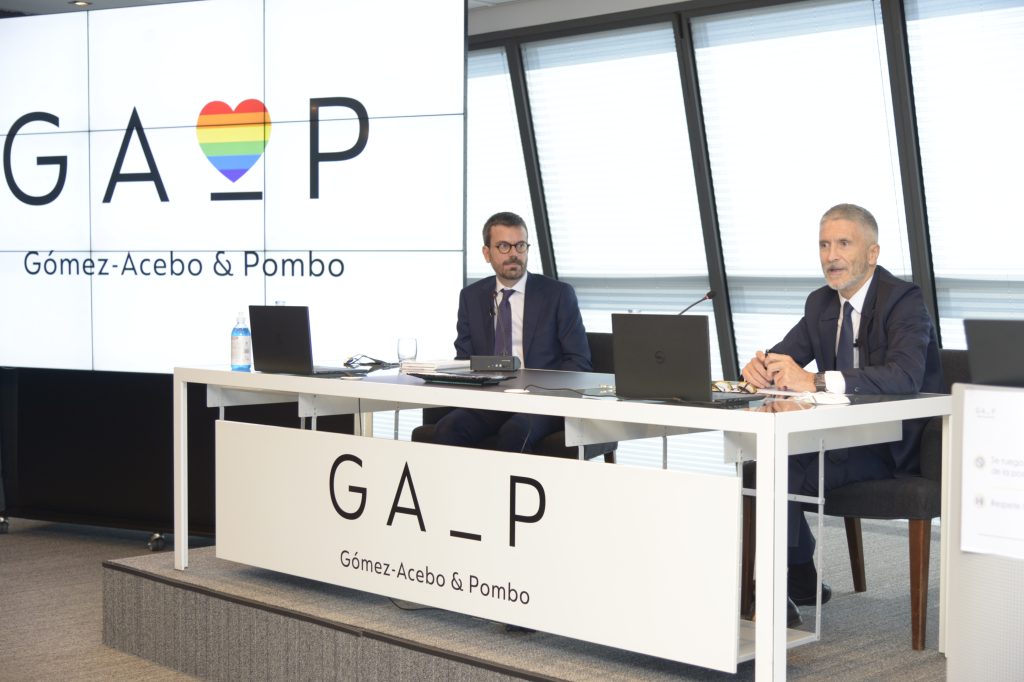
Ferran Foix, partner of the London office of Gómez-Acebo & Pombo and member of the Diversity and Inclusion Committee (left) with Fernando Grande-Marlaska, Minister of the Interior (right)
Gómez-Acebo & Pombo has welcomed the Minister of the Interior, Fernando Grande-Marlaska, to highlight the LGBTQ+ Pride week and in the year in which the firm celebrates its fiftieth anniversary. The presence of the minister today inaugurated a new initiative promoted by the Gómez-Acebo & Pombo Diversity and Inclusion Committee, a forum in which personalities from different fields such as economics or politics share their experience and vision on diversity and inclusion as members of the LGBTQ+ collective.
The minister, known as one of the most influential people of the LGBTQ+I collective in Spain, has left some key ideas about the need for education in tolerance and the importance of promoting values that build a society with less prejudice.
In the words of Carlos Rueda, managing partner of the Firm “Making these issues visible is essential for promoting tolerance and respect in our companies and in society. Gómez-Acebo & Pombo wants and has the responsibility to contribute to our society moving in that direction. “Additionally, Ferran Foix, partner of the London office and member of the Diversity and Inclusion Committee, highlights “At GA_P we have been working for a long time on an internal culture that fosters values such as equality, diversity and inclusion. We must continue to advance in true respect, acceptance and normalization of the LGBTQ+ community and we hope that a forum like #GA_Pproud helps make these issues visible”.
The session took place first thing in the morning at the Gómez-Acebo & Pombo headquarters in Madrid located in Plaza Castilla and was exclusively internal.
This event has been picked up by Cinco Dias. You can read about it here.

Press contact

Director of Business Development, Marketing and Communications


Director of Business Development, Marketing and Communications

More information about
Gómez-Acebo & Pombo

 5 days ago

PUBLICATION
 3 days ago
Emails sent by a company to its staff during collective bargaining do not always violate freedom of association
Emails sent by a company to its staff during a negotiation process do not, in and of themselves, constitute anti-union interference or unlawful pressure, provided they fall within the scope of the company’s freedom of expression and the legitimate defence of its business interests.
3 days ago 
PUBLICATION
3 days ago
Public consultation now open on the Royal Decree regulating the requirements for energy sustainability, environmental sustainability, digital resilience and digital sovereignty applicable to data centres
3 days ago
PUBLICATION
3 days ago
Agreement offsetting leasehold improvements against future commercial lease payments: third-party purchaser takes the stage
Is a set-off agreement enforceable against a purchaser seeking to collect new lease payments? Although the answer is not clear-cut, ultimately the lessee will not leave without compensation for the improvements
3 days ago
PUBLICATION
31 Jul, 2026
Automotive and Sustainable Mobility No. 31
Summary of legislative and jurisprudential developments relating to the automotive sector.
31 Jul, 2026
PUBLICATION
28 Jul, 2026
Derogations from the principle of supervision in the home Member State in respect of information society services and control over content by means of an algorithm
The Court (Grand Chamber) defines the scope of derogations from the principle of supervision in the home Member State for information society services on grounds of public policy, security and safety, clarifying the distinction between general prohibitions and individualized measures directed at specific providers. It also provides important criteria regarding the liability of digital platforms, holding that control exercised by means of algorithms may preclude the application of the exemption from liability provided for data hosting services.
28 Jul, 2026
PUBLICATION
23 Jul, 2026
New regime for giving international effect to judicial sales of ships
UN Convention on the International Effects of Judicial Sales of Ships establishes a mechanism to ensure that judicial sales of ships which confer clean title in the State Party in which they are conducted produce the same effect in other State Parties without bureaucratic obstacles that hinder trade in this sector.
23 Jul, 2026
PUBLICATION
22 Jul, 2026
Shipowner and package travel organiser: on whether the limitations of liability under the Athens Convention apply
The matter at issue is whether the shipowner, which provides a passenger transport service as part of package travel organised and sold by a travel wholesaler or retailer, may invoke the limitations of liability specific to maritime transport against the tourist and against the organiser; but, above all, whether the organiser may also invoke them against its client.
22 Jul, 2026
PUBLICATION
21 Jul, 2026
Simplification of sustainability reporting and standards for voluntary use by SMEs
Pursuant to Directive (EU) 2026/470 of 24 February (Omnibus I), the Commission has adopted a delegated regulation amending sustainability reporting standards (ESRS) and another that includes sustainability reporting standards for voluntary use by SMEs in the value chain of large undertakings that are subject to mandatory sustainability reporting. The amended European sustainability reporting standards will apply from the 2027 financial year, although large companies may choose to adopt them from the 2026 financial year.
21 Jul, 2026
PUBLICATION
17 Jul, 2026
Claim assignment and assignment of right to rescind underlying contract
There is no single answer to the question of whether or not the assignee of a claim has the power to rescind the underlying contract when the assigned debtor defaults. As a general rule, such rescission will not be possible for the assignee.
17 Jul, 2026